Category: Uncategorized

  • RESULTS – TENDER GARNACHA GRENACHE CAMPAIGN IN USCAMX

    The ENTITIES (ASOCIACION PARA LA PROMOCION DEL VINO DE GARNACHA – “GARNACHA ORIGEN” and CONSEIL INTERPROFESSIONNEL DES VINS DU ROUSSILLON (“CIVR”), after opening the bids, revising every proposal received and meeting the top ranked finalists per category (lot/WP), have prudently evaluated according to the EU criteria and are pleased to announce the winning proposals for the potential Multi European Garnacha/Grenache in the United States, Canada and Mexico: 

    Both entities really appreciate all bidders for their interesting and complete
    proposals and remain available for any relatted matter.

    The selection of subcontractors has been based, scored and weighted according to
    the following criteria:

  • OPEN CALL FOR TENDER GARNACHA GRENACHE CAMPAIGN IN USCAMX

    Tender for the selection a
    subcontractors for the development of activities for a multi European Programme in
    accordance with Regulation (EU) N°1144/2014

    DOWNLOAD USCAMX Tender

    Introduction

    The European Union co-finances information and promotion programmes for agricultural products on the internal market and in third countries in accordance with Regulation (EU) 1144/2014 of the European Parliament and the Council.
    These rules lay down the procedure, the agricultural products covered by these programmes and the countries in which they may be developed. Article 20 of Regulation (EU) No 1144/2014 sets out the procedure for selecting the implementing body responsible for implementing the programmes.

    For the definition and execution of these programmes, the POTENTIAL CONTRACTING ENTITIES hereinbelow seek the collaboration of promotion agencies that will work on the development and execution of the promotion activities incorporated into the programmes if they are finally granted European funding. To this end, a selection process is now initiated, calling for tenders to those agencies who wish to participate and which, on the basis of their merits and experience, could contribute most to the promotional objectives pursued by the POTENTIAL CONTRACTING ENTITIES.

    POTENTIAL CONTRACTING ENTITIES are interested in submitting a program linked to the 2025 CALL FOR PROPOSALS MULTI PROGRAMMES for Grants to information provision and promotion measures concerning agricultural products implemented in the internal market and in third countries in accordance with Regulation (EU) No 1144/2014 of the European Parliament and of the Council (2019/C 18/05), and are selecting subcontractor(s) to develop a promotional campaign of the European Garnacha / Grenache Quality Wines in the US, CA and MX  (“the potential program”).

    1. Type of Tender: Open Call for Tender.

    2. Potential Contracting entities

    a)    ASOCIACION PARA LA PROMOCION DEL VINO DE GARNACHA – “GARNACHA ORIGEN”.

      • VAT No. ES-G99398935
      • Address : Avda/ Ranillas, 3A, Planta 2, Oficina A, 50018 Zaragoza, Spain
      • Contact person: Ms Carolina de Funes
      • Email: c.defunes@garnachaorigen.com

    b)    CONSEIL INTERPROFESSIONNEL DES VINS DU ROUSSILLON (“CIVR”)

      • VAT No. FR11434310300019
      • Address : 19, Avenue de la Grande Bretagne. 66006 Perpignan, France.
      • Contact person: M. Eric Aracil
      • Email: eric.aracil@roussillon.wine

    3. Type of Agreement: Services Agreement

    4. Overall Target: Promotion of European Garnacha/Grenache Quality Wines in third countries.

    5.    Target markets: in the United States of America, Canada and Mexico. The % of the actions to be developed in each country will be estimated at 40% USA, 40% Canada, and 20% Mexico.

     6.    Target audience and suitable activities:

    • Academy: Master Class
    • Trade: Roadshows, pairing lunch, study trips
    • Media: Master Class, study trips, sample distribution, press release
    • Final consumers: Online stores, in-store tasting, social media, festivals.

    7.    Considerations and Description of Services to be provided by the selected subcontractors:

      The proposals from the applicants must cover the following aspects:

    • Strategic analysis
    • Creative proposals that address the campaign objectives
    • Detailed action plan per country
    • Campaign implementation schedule for each market
    • Criteria to follow to ensure the best value for money in the proposal
    • Suggested quantifiable KPIs for each element of the campaign
    • Complete preparation, implementation, and periodic reporting for the following activities:

    Hereby includes a list of suitable activities for each target audience, however additional activities or other activities can be considered according to the reality of the market.

    • Public Relations suitable activities
      • Press trip The trip includes a visit to the French and Spanish PGIs & PDOs (Roussillon + Terra Alta/Priorat + PDO Campo de Borja, Cariñena, Calatayud) Guests from the US, Canada and Mexico. The proposal will include a very attractive activity during the trip. (Minimum 6 participants.)
      • Press office: press dossier update (translation into Spanish and French) and press releases in the US and Canada. Other proposals such as a Garnacha Grenache ambassador or samples distribution in the US and Canada, will be valued.
      • Master class: In the US and CA
    • Website and Social Media
      • Website – Redesign and update the website testsite.tukan.ee/. Translation into French and Spanish. Increase website Google ranking and support SEO efforts. Regularly update the Events/news and wines section.
      • Social media – Facebook and Instagram in the US, use of the existing social media.
      • Tools and Development of content– Creativities, video, Apps… we look forward a very dynamic social media and digital communication tools, and the use of the latest technologies such as AI will be a must.
    • Communication Tools 1
      • Documentary Video production. Documentary Video production of about 50/60 minutes. Filming in Spain and France , mainly in the following PDOs: Roussillon, Terra Alta, Priorat, Cariñena, Campo de Borja, and Calatayud.. Languages: EN, FR, ES. Require a professional narrator and sound studio.

        The aim of the video is an educational tool potentially promoted in TV platforms. Contractors will provide necessary profiles for potential interviews, guidance, and some support documents for writing the script. Technical specifications.

    • Communication Tools 2
      • Branding – Redesign the identity and adaptation to the communication tools by market during the campaign.
    • Events: suitable activities (40% US, 40% CA, 20% MX)
      • Trade trips The trip will include a visit to the French and Spanish PGIs & PDOs (Roussillon + Terra Alta/Priorat + PDO Campo de Borja, Cariñena, Calatayud) Guests from the US and MX. Need to include a very attractive activity during the trip. Minimum 6 guests.
      • Roadshows – Private tastings with at least 80 attendees (operators). No need to focus on the first markets. The roadshow will include at least 4 cities per year (US and CA) and must prove the versatility of the grape through pairings.
      • Master Classes – Mainly in Wine Academies and leading wine events in the US and CA.
      • Pairing lunches – Exclusive pairing lunch with importers (approx..10 importers) in the first markets of the US and MX (New York, Miami, Chicago, Las Vegas, Dallas, Ciudad de Mexico…)
      • Festivals: Target market US, target audience: final consumer.
    • Point of Sales – In-store tastings in the US, CA and MX. 
    • Evaluation: The evaluation body will carry out impact evaluations of the action, measured against the objectives and indicators of the EU program funding the grant. Evaluation will be measured by a specific survey conveying a mix between consumption and visibility. These indicators will be evaluated yearly and measured on a wine consumption solid panel. Measurement of the exports and market share on a historical trend basis, taking into account indicators status before activities begin and by the end of the three-year program. Analysis of surveys collected during the campaign actions. 

    8. Implementation period:

    Start date: 2026

    Duration: 3 years

    The final dates will be the ones included in the Grant Agreement.

    9. Agreement Term: the Agreement Term will be longer than the implementation period, to allow the performance of some obligations to survive and allow Program preparation and evaluation.

    10. Total Budget: 2.596.950,00 € Euros.

    11. Selection criteria of the subcontractors: best value for money while preventing situations where conflict of interest is deemed to occur. The selection of subcontractors will be based, scored, and weighted according to the following criteria:

    12. Deadline for obtaining information and documents: 21/02/2025 15:00 CET . We remain at your disposal to provide further information at the email address: c.defunes@garnachaorigen.com

    13. Presentation of offers or requests for participation.

    • Deadline for submission of offers: 23/02/2025 23:59 CET
    • Documentation to submit (entirely written in English):
      • A letter of intent to bid on paper letterhead, dated and signed by the person authorized to bind the company.
      • Summary of the economical offer per activity following this template
      • A detailed Action Plan proposal, including:
        • Description of the proposed activities and methodology to implement the actions (KPIs) (LOT 1, 2, 5, 6, 7)
        • Description of the proposed activities and methodology to implement the actions (LOT 3 and 4)
        • Description of the proposed evaluation methodology and indicators (LOT 8)
        • Estimated schedule
        • A detailed annual budget expressed in euros, with a breakdown of the management fees and detailed implementation costs.
      • Annexes for supporting documentation to substantiate existence, financial and technical capacity as well as experience:
        • A sworn statement on letterhead, dated and signed by the person authorized to bind the company, that the
          candidate has not been banned from bidding or fall under any of the exclusion criteria listed on the basis of the 2025 Call for Multi Proposals, in accordance with Regulation (EU) No 1144/2014.
        • Certificate proving that the bidder is in order with regard to its tax obligations by 31 December of the previous year.
        • Certificates proving that the bidder is in order with regard to its labour and social security obligations by 31 December of the previous year.
        • A statement of overall turnover and the turnover concerning the services to which the contract relates, executed over the past three years in the targeted markets. (Not necessary in the targeted markets if a subcontractor applies only for Lots 3 and 4.).
        • A list of the main services provided in the past three years in the target markets and regarding the wine industry, including the amount, date, and recipient (public or private). (Not necessary in the targeted markets if a subcontractor applies only for Lots 3 and 4.).
        • Team presentation: names of those responsible and performers who provide the requested service and professional qualifications (academic and/or professional experience). Organization chart.

    Submission of proposals: by filling this online form. Each bidder must ensure that the application is successfully submitted before the deadline.

    This material must be delivered digitalized in a suitable support. This information should give the tender a fair idea of the match between their needs and the agencies’ offers and the agencies’ ability to manage a campaign co-financed by the European Union at both technical and administrative levels.

    Potential contracting entities will revise every proposal and ask the 3 top ranked finalists per category under the abovementioned criteria for a digital or in-person audiovisual presentation to be held in Zaragoza (Spain) on 28/02/2025.

    14. Contract award: The award will be notified to participants by email and publication on the contracting entitie’s websites within a maximum period of thirty (30) days from the deadline for submission of offers.

    15. Conditions and next steps:

    The aim of this competition is to apply for a promotion program with European co-financing. The deadline foreseen by the European call implies that a firm and definitive response will not be possible before October/November 2025. As a result, the selected subcontractors must undertake to maintain the validity of their offer until then and it will not be possible to sign a contract before December 2025.

    If funding from the European Union is not guaranteed, the competition will be declared null and void.

    This tendering exercise is not remunerated: no financial compensation is provided to applicants whose bids are unsuccessful. All information sent to successful applicants must be treated as strictly confidential and due to the institutional nature of the data cannot be used for other clients.

    Once the final subcontractors are chosen in March 2025, they undertake to assist the potential contracting entities in the preparation of the application for European funds in accordance with the requirements and scales presented in the 2025 CALL FOR PROPOSALS MULTI PROGRAMMES, as well as the information specified in the GUIDE FOR APPLICANTS of multi programs for co-financing of information and promotion measures implemented in the internal market or in third countries.
    Among other matters, but not exclusively, the collaboration will be based on the following sections:

    • Application form: Part B – Technical content
      • Products/schemes and market analysis, SWOT
      • Action objectives & KPIs
      • Action strategy
      • Description of activities and analysis of budget positions
      • Measurement of results
      • Management and CV of the structure

    If the applicant is already managing a campaign by an operator in the same sector or a sector or entity that could give rise to a conflict of interest, that operator or entity must give an advance agreement for the applicant to participate in this tender. If this applicant is selected, an advance agreement is also required before accepting any future campaign from an operator in the same sector or from a sector or entity that may give rise to a conflict of interest.

    Once the creative work of the successful applicant has been agreed and paid for, it becomes the property of the CONTRACTING ENTITIES without limitation of time or place, and this includes use for all methods of communication and media.

    CONTRACTING ENTITIES reserve the right to use creative concepts (images, logos, slogans, and domain names) within the context of their other campaigns and without time limitation.

    The selected subcontractors must sign a contract with the CONTRACTING ENTITIES. Expenditure may not be incurred until a framework contract has been signed between the tenderer and REA and a contract between the tenderers and the successful agency.

    16. Notice on EU funding: This call for tender is related to REA´s “Grants to information provision and promotion measures concerning agricultural products implemented in the internal market and in third countries in accordance with Regulation (EU) No 1144/2014 of the European Parliament and the Council” and subcontractors must comply all obligations and conditions applicable and set out in the Multi-Beneficiary Model Grant Agreement, as well as Regulation (EU) No 1144/2014 of the European Parliament and the Council related legislation, specifically covering liability, indemnification, and confidentiality arrangements. 

    The final elected implementing body and subcontractors must collaborate to fulfill all terms and conditions mentioned in the abovementioned Grant Agreement, including, specifically, all the obligations and conditions in the following related EU regulations available at EC Funding & tender opportunities Portal:

  • Grenaches du Monde: An Olympic edition!

    On May 13th , the international competition dedicated to the Grenache grape variety celebrated its 12th edition in Paris, the ‘Grenache’ and… Olympic capital!

    After its excursion to New York last year, the competition is positioning itself in one of Europe’s leading consumer and prescription markets. A panel of around a hundred international experts picked the best Grenache wines in the lounges of the Aéro Club de France (Paris, 16º) which you can check the results here https://www.grenachesdumonde.com/ .

    Grenaches du Monde is an annual competition open to all Grenache wines (pure or blended), regardless of colour, origin, or nationality. With 163,000 hectares of vineyards, Grenache is the seventh most planted grape variety in the world. It is the emblematic variety of the Mediterranean countries, mainly Spain and France, which together account for almost 90% of the world’s planted area. Spain, France, and Italy are the three main producing countries, flying the flag for Europe, but Grenache is very popular all over the world: North and South Africa, Australia, North and South America, Croatia, Greece, Lebanon, etc.

    In a dynamic, business-like format, Grenaches du Monde aims to attract an audience of demanding and influential professional tasters from all over the world, to discover the richness and diversity of this emblematic grape variety. A time for sharing and conviviality, Grenaches du Monde celebrates the culture and know-how of Grenache producers at an event that has become a must in the professional calendar, highlighting all the producers and all the regions that make Grenache wines, in all their forms: red, rosé, white, sweet or sparkling. This twelve edition was a consecration for this unique grape variety, which is winning over more and more wine-lovers and consumers around the world.

  • Grenache wines, valued in the USA thanks to the “European Garnacha/Grenache Quality Wines” campaign

    Many Americans already identify Garnacha/Grenache wines with the international symbol of quality with European origin. And they know and value them because of the promotional campaign co-financed by the EU: “European Garnacha/Grenache Quality Wines Program”, promoted by the Asociación Garnacha Origen de España and the Conseil Interprofessionnel des Vins du Roussillon /CIVR, from France, which ran from January 2020 to February 2024.

    Thanks to these years of campaigning, European Garnacha/Grenache wines have managed to seduce the palate of Americans not only for their quality, but also for their flavors and versatility when it comes to pairing with different dishes.

    About 23% of wine consumers in the United States drink often, that is, once a month or more. Precisely, among these consumers and those who have drunk in the last six months, more than 75% already know Garnacha/Grenache as a grape grown in Europe, according to the latest Wine Intelligence survey conducted in January 2024 in the USA. France and Spain are the top countries for consumption.

    In fact, the consumption of this European variety has also advanced in the last two years; now it is consumed by 1 out of 5 wine drinkers, 20% of them. Compared with the consumption of this variety in 2022 (16%), it has increased by 4 points.

    In addition, most Grenache wine drinkers, over 80%, think those wines are of high quality, this proportion is on the rise since 2022 (+5ppt vs Y1).

    Close to 50% of US regular wine drinkers have already seen the PGI / PDO logos, and just under 20% know their meaning. About 3 in 4 understand the logos to be indicators of a product’s geographic origin and traceability, and approximately 60% consider them symbols of quality assurance.

    These good figures confirm that the “European Garnacha/Grenache Quality Wines” campaign has given greater visibility to these wines among American consumers, who today have a better understanding of the link between Garnacha/Grenache and European quality products. In fact, 70% of respondents by Wine Intelligence are, likely to very likely, change their list to integrate more Garnacha / Grenache wines in the next 12 months.

    In short, the Balance Sheet The Campaign Developed in the United States has been positive: it has achieved millions of Impacts thanks to spreading messages related with the story of the grape Garnacha/Grenache and its Quality Standards. The origin of its quality standards has been talked about, and the terroir where they are grown, the harvest, its characteristics, traceability, tradition, pairing, consumption, versatility, technology, and the diversity of the grapes, colors, flavors…, etc.

    Activities that have reached the public

    To make Grenache known to thousands of American consumers, a special program has been organized – called ‘European Garnacha/Grenache Quality Wines’ – which has included a wide range of activities such as the dissemination of Grenache information in the American media, participation in walk-around tastings, attendance at fairs in the main cities of the USA, such as New York, Miami, San Francisco, Dallas, Chicago, Los Angeles and San Diego, invitation to visit the “Garnacha Grenache Land” to journalists and professionals, tastings in the major U.S. wine supermarket chains and online marketing.

    Another stellar event of the campaign was the celebration of the 11th edition of the International Competition ‘Grenaches du Monde’ that took place in the USA in June 2023, under the slogan “From Europe to the World”. This novelty broke with the tradition of celebrating this event, that since 2013 had been organized in Europe. American professionals from the wine industry evaluated around 800 excellent grenache wines from all over the world.

    On September 14th, on the eve of International Grenache Day, the participants of the competition were honored in what was the largest Garnacha/Grenache tasting ever held in the USA. A special gala was held in which the Mayor of New York, Eric Adams, proclaimed International Grenache Day in the city, while experts and personalities from the wine sector lived a unique experience.

    During the 3 years of the program, European Grenache/Garnacha wines have been represented at the major American wine trade shows and events. From Vinexpo in New York, to IBWSS San Francisco, SommCon in San Diego, and from TEXSOM to WSWA in Las Vegas, a big part of the United States territory was covered through this presence, providing a unique opportunity for the American market to discover first-hand the quality, flavor, diversity and tradition of these wines.

    Grenache was also the protagonist of 16 seminars in total, conducted by some of the leading experts in the sector, all within the framework of these important trade events. A series of successful meetings that had highlights at Vinexpo America (New York, 8 March 2023) and SommCon (San Diego, 10-12 September 2023), where they were completely sold out.

    Possibly the most ecofriendly grape


    In all these meetings, Garnacha/Grenache has been presented as one of the most planted grapes in the world, and one of the most ecofriendly. Its origin goes back to Europe, where almost 93% of the world’s plantations are located, specifically France and Spain where the highest concentration is at.

    This variety was presented as one of the most resistant to drought, but it is also self-sufficient, adaptable, and self-sustainable. Its strong roots dig deep into the soil in search of moisture and nutrients. It is known as the non-water-stressed variety because it does not depend on rainwater or irrigation like other grapes. All this was recognized at the World Conference on Climate Change and Wine held in Marbella (Spain) in 2011, where it was pointed out that “Garnacha/Grenache is possibly the most ecological grape in the world”.

    Also, during this promotional campaign, special efforts have been made to raise awareness among the American consumer of the importance of the European quality labels and their value in guaranteeing the quality of this product to the consumer. And the different specificities that accompany EU agricultural production that have been made known are food safety, traceability, authenticity, labelling, nutritional and health aspects, respect for the environment and sustainability; and its characteristics in terms of quality, taste, diversity and traditions.

    The wide diversity and the pairing possibilities of this variety have also been responsible for many followers, and for many interactions from our fans on social media during the 3 years of the program.

  • The different flavors and aromas of European Garnacha/Grenache grapes

    The versatility of the European Garnacha/Grenache is another of the strengths of this quality grape. This is because there are different Garnacha grape varieties. The most surprising thing is the diversity of the wines they can produce and their different characteristics (color, flavor and aroma) that appear depending on these grape varieties, on their place of cultivation (terroir), on the way of vinification and ageing.

    © J.Muñoz

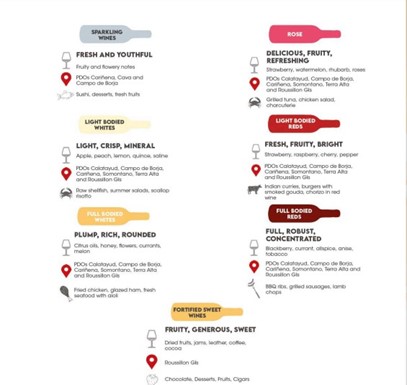
    Garnacha/Grenache is a great chameleon and comes in different varieties: red, white, and grey (as well as a red and hairy vine, so called this because of its “hairy” leaves). It also comes in many forms: red, rosé and white dry wines, sparkling wines, natural sweet and fortified sweet wines. Consequently, there are different styles of European Grenache from the northeastern regions of Spain and the south of France, where the grape originates.

    For example, sparkling Garnacha is making its way into the Spanish appellation of Cava. These regions have continental climates and high-altitude vineyards that preserve acidity and deliver white cherry, floral and herbal flavors. Sparkling Grenache can be dry or sweet, young or long aged, and always very fresh.

    The higher altitudes, mineral soils, and maritime influence favor a white wine style of white and grey Garnacha, light-bodied and crisp. The PDO Cariñena and Campo de Borja excel in these wines, as do the Spanish regions of PDO Calatayud, Somontano and Terra Alta, and the French PDOs of Collioure, Côtes du Roussillon, and PGI of Côtes Catalanes and de la Côte Vermeille. In those cases, they are elegant and fine and can have apple, peach, quince, lemon, and saline elements.

    Full-bodied whites can also be found in these regions, with the warmer Mediterranean climates of PDO Terra Alta and PDO Collioure, Côtes du Roussillon in Roussillon bringing a little more body to the Grenache (PDO Terra Alta is home to around 30% of the world’s Garnacha Blanc plantings). These round whites can offer flavors of citrus oil, honey, redcurrant and melon, along with a bouquet of floral aromas.

    Dry rosé is relevant in the Mediterranean, and Garnacha/Grenache appears throughout northeastern Spain and in the GIs of Roussillon in a variety of styles. The slate vineyards of the PDO Calatayud and its ample sunshine can favor the more robust, mineral and black-fruited versions, while the wine from the PDO Cariñena is more floral and herbaceous. Strawberry, watermelon, rhubarb and rose are the hallmarks of these refreshing and lively European Grenaches. Very versatile for pairing with a strawberry salad or a shrimp cocktail. The rosés wines from Roussillon, southern of France, from AOP Collioure and Côtes du Roussillon, IGP Côte Catalane and de la Côte Vermeille, are also in the same line with a good freshness and juiciness of orange and grapefruit.

    Elegant and characterful, the light-bodied red Garnacha could accompany fish, poultry, and vegetarian dishes. With aromas of strawberry, raspberry, cherry and pepper, these wines are found in the north-east of Spain and the south of France in particular, where in the best conditions, cool nights and regular breezes balance ripeness and acidity.

    @BodegSanValero


    The Campo de Borja and Cariñena appellations offer very good expressions, as do the more prominent communes of the Côtes du Roussillon Villages appellations: Caramany, Latour de France, Lesquerde, Tautavel and les Aspres, offering among others a range of lighter style Grenaches, many made with carbonic maceration and minimal use of the oak containers to preserve fresh fruit flavors.

    Full-bodied red Garnacha remains a specialty of this corner of the wine world, as poor soils, dry conditions, old vines with deep roots and low yields concentrate the flavors and tannins of the grapes, resulting in robust, structured wines with deep flavors of blackberry, blackcurrant, allspice and tobacco. In the Roussillon PGIs, winegrowers cultivate grey and black schist vineyards to make the rich Grenache wines of the PDO Collioure and Maury Sec, while the Somontano and Calatayud PDOs in Spain produce bold Garnacha with ripe fruit and a mineral background.

    The Roussillon Geographical Indication has long been considered one of Europe’s most prized regions for dessert wines and is home to the fortified Vins Doux Naturels (VDN) of PDO Maury, PDO Banyuls, PDO Banyuls Grand Cru and PDO Rivesaltes. Those appellations give the opportunity to taste the purity of the full family of Grenaches variety, either in very fresh style, for all the colors, or in delicate, rich and complex oxidized styles.

  • European Garnacha/Grenache, paradigm of resistance and evolution

    Only a handful of vines survived the terrible phylloxera plague at the end of the 19th century. But that was enough for us to be talking today about this unique variety, the European Garnacha/Grenache, which is increasingly on the rise, and its wines, of incredible finesse, concentration and complexity.

    ©Chris Martínez

    Its proven resistance over time – to pests, drought conditions, poor and dry soils, etc. – has resulted in a great Garnacha/Grenache heritage and wines with a strong sense of place. Known as Garnacha in Spain and Grenache in France, this peculiar and versatile variety -which grows on old vines with deep and stable roots- is nowadays very popular in its place of origin. One of the reasons for its boom is the great work done by the new generation of European winegrowers -based precisely in the north of Spain and the south of France- which make innovative wines with Grenache as the protagonist.

    The winegrowers in these areas are reclaiming their heritage and producing wines with great personality because they are more familiar with the growing conditions at an altitude from 0 to over 700  meters, and they take care of every detail of the process, from cultivation to harvesting; they incorporate different fermentation vessels and raise the quality of the barrels / wooden tanks. Moreover, the old vines, once despised for their low yields (each old vine produces no more than one kilo of grapes), are now celebrated for their rich, concentrated expression.


    Quality techniques and great evolution

    Producing a good single-varietal Garnacha/Grenache wine is no small challenge and requires care and some specific rules to be followed. The winegrowers of these geographical indications manage to produce excellent single-varietal wines with highly developed techniques that result in magnificent wines. These Geographical Indications bring together the five Protected Designations of Origin of northeastern Spain: Calatayud, Campo de Borja, Cariñena, Somontano, Terra Alta, the 14 PDOs of southern France which for their part are made with this single variety or in blend: Banyuls, Banyuls Grand Cru, Collioure, Côtes du Roussillon, Côtes Du Roussillon Villages, Côtes du Roussillon Villages Latour de France, Côtes du Roussillon Villages Lesquerde, Côtes du Roussillon Villages Caramany, Côtes du Roussillon Villages Tautavel, Côtes du Roussillon Villages les Aspres, Maury Sec & Doux, Rivesaltes, and the 2 Protected Geographical Indications also from the South of France: Côtes Catalanes and de la Côte Vermeille.

    These guidelines are as follows:

    Low yields. It is essential to keep yields low to respect the durability of the vine, to improve concentration with little or no irrigation. There is even evidence that Garnacha/Grenache reacts intelligently to a slight degree of water stress.

    Old vines. Reduce yield and increase concentration.

    Poor soils. Garnacha/Grenache can produce excellent wines on a wide variety of soils. There are very good wines made with Garnacha/Grenache on all schists, granite and limestone; the poorest soils giving one of the best results. But whatever the mineral composition, it is essential that the soils are warm and with excellent drainage for the roots to go deep.

    – Low / controlled temperature alcoholic fermentation. This is essential to preserve freshness. In several red wines, a cold pre-fermenting maceration is done. Thanks to that, the refining of the maceration takes place during the early stages of the alcoholic fermentation, to add color and tannin, but is stopped before the wines can become too tannic, and all the process is under quite low temperature to keep a maximum of fruits’ pleasure.

    For the vinification of white or rosé, especially to retain freshness and minerality, even for Sparklings or Vins Doux Naturels, the control of temperature is compulsory.

    Thanks to the evolving of the technology, the wine maker can take advantage of the coolling machines or even doing its work in an air conditionned cellar. This is helpful for a use of barrels.

    All of this results in better European Garnacha/Grenache wines that are world-renowned.

  • The ‘heroic’ work of European Garnacha/Grenache

    There are wine-growing areas within the ‘European Garnacha/Grenache Quality Wines’ program with specific geographical features that make vineyard work more complicated than usual. In addition to the vine cultivation and harvesting work, which is complex in itself, there is the manual work that is very often carried out on a steep slope at high altitude.

    This is what is known as “heroic viticulture”, very much focused on certain high-altitude areas. These are vineyards that must meet some of the following requirements to be called “heroic”: a terrain with more than 30% slope, an altitude of more than 500 meters above sea level or vineyards on terraces. Heroic viticulture vineyards are rare, and in Europe only 5% of the vineyard responds to these peculiarities.

    ©Vins du Roussillon

    Working in these areas is generally risky, given the slope on which the vines are located. Moreover, the work here is done manually, as mechanization is almost impossible due to the unevenness of the terrain.

    Within the ‘European Garnacha/Grenache Quality Wines’ program, one of the areas with vineyards that are difficult to access is particularly Collioure / Banyuls (Sur Mer) in the Pyrénées-Orientales in the South of France. In these areas, the cultivation, maintenance and harvesting of grapes are heroic, as they are conditioned by the distribution of the vineyards in terraces. Those are used to overcome the slope of the land, avoiding the erosion… and yet, for instance, each two years, the winegrower needs to bring back the soil from down the slope to the upper terraces…, the mechanization is impossible, because it is too risky for the worker and for the vine.

    This French area is in its whole like an amphitheater, dominated by heights that are often difficult to cross, separating it from the neighboring provinces. Geologically, it is a rugged place that underwent drastic changes during the Tertiary and Quaternary periods. After the uplift of the Pyrenees, the southern and northern parts of the Eastern Pyrenees developed very differently.

    With 14 AOP: (Banyuls, Banyuls Grand Cru, Collioure, Côtes du Roussillon, Côtes Du Roussillon Villages, Côtes du Roussillon Villages Latour de France, Côtes du Roussillon Villages Lesquerde, Côtes du Roussillon Villages Caramany, Côtes du Roussillon Villages Tautavel, Côtes du Roussillon Villages les Aspres, Maury Sec & Doux,  Rivesaltes and Muscat de Rivesaltes – the unique one which is not made with Grenaches) and 2 IGP (Côtes Catalanes and de la Côte Vermeille), mainly from 25 different grape varieties, the wines of this area in the south of France are very rich and each one expresses its own character.

    It also has one of the highest proportions of old vines in the world, on the most varied soils up to 750 meters, with 80% of the vineyard located along rugged mountainous terrain. This situation, its warm, dry climate are well suited to Grenaches (38% of the vineyard). It therefore offers the perfect conditions to produce quality wines.

    ©Vins du Roussillon

    In the north-east of Spain – DO Calatayud, DO Campo de Borja, DO Cariñena, DO Somontano, and DO Terra Alta – there are some areas of Garnacha vines located at high altitudes – a determining factor in the production of quality wines. These regions have steep slopes and altitudes between 300 and 1,100 meters above sea level. At this altitude, Garnacha vineyards are cultivated with great care and without irrigation, resulting in excellent wines.

  • Tourist routes in the European Garnacha/Grenache area

    ©Turismodearagon

    Visiting natural parks, villages and environments surrounding Garnacha/Grenache producers, especially those located in northeastern Spain and southern France, is a delight for the senses.

    Each of the Protected Designations of Origin (PDO) and Protected Geographical Indications (PGI) belonging to the “European Garnacha /Grenache Quality Wines” program offers a myriad of interesting activities that serve as a stimulus for tourism in these spectacular enclaves, while at the same time becoming a great opportunity to learn about the history of this unique variety. Here are some examples:

    Campo de Borja PDO. In this area of Aragon (northeastern Spain), a visit to the 16th century Palace of the Counts of Bureta, an authentic hillside winery with a centuries-old tradition in Aragon, is of great interest. Do’t miss the route through the caves dug by pick and shovel in soft soils where families traditionally made their own wine. This PDO is one of the oldest in Aragon, and its vineyards have been documented since 1203. A compelling reason to visit the vineyards where Garnacha is the main protagonist, with 80% of the total crop. The area also offers a bicycle route of about 152 kilometers of landscapes and vineyards. In addition, you can have a fun ride through these wineries on the hill on a sled with wheels pulled by dogs, called ‘mushing‘.

    Cariñena PDO. The Campo de Cariñena Wine Route revolves around wine, of course, but also water, ceramics, Roman remains, Goya’s paintings, charming villages, and lots of nature. In this sense, the producers of this PDO offer outdoor tastings, live jazz, dinners, yoga clases, and artistic painting or watching the Perseids among the vineyards. The Cariñena PDO is the oldest and dates to Roman times. Its fame increased in the late Middle Ages, but its European recognition began in 1865.

    ©Turismodearagon

    Calatayud PDO. A mountain range of vineyards and Mudejar art -the church of Santa María del Tobed, declared a UNESCO World Heritage Site in 2001, stands out- but also a territory with spectacular landscapes, gorges, rivers and ravines, whose most relevant monument is the Monasterio de Piedra, dating to the 12th century. Inside is the Wine Museum of the Protected Designation of Origin Calatayud. The landscape of this area is perfect for hiking and has a wide range of spas with mineral-medicinal waters, golf course and a magnificent heritage legacy where you can visit the wineries of this PDO and taste its excellent wines.

    Somontano PDO. Its wines enjoy a great reputation and the landscapes of its vineyards, and the nearby Natural Parks make a visit to Somontano a memorable trip. In this area, 4,000 hectares are cultivated with vines and more than 30 wineries. One of the most interesting destinations in this appellation is Barbastro, a beautiful town with great gastronomic richness and exceptional wines made with Garnacha/Grenache. Also, the Somontano wine bus allows a dream route that goes through crypts, wineries, and localities with guided wine tastings.

    The Calatayud, Somontano, Campo de Cariñena and Campo de Borja Wine Routes have joined forces to form the Enoturismo Aragón brand to promote themselves jointly and thus intensify their presence in the market.

    Terra Alta. In this beautiful land of Tarragona, you can immerse yourself in unique landscapes that inspired Pablo Picasso and that he captured in his paintings. Away from the big cities is a hidden area full of culture and wine tradition where the traveler can get lost visiting wineries and strolling through the vast fields of vineyards. The wine together with the gastronomy make it an ideal place to travel, enjoy, and get the most enological part out of it.

    And in the south of France, the producers of these PDOs and PGIs offer as many tourist activities that are also very attractive:

    From Collioure to Port-Vendres, Banyuls-sur-Mer and Cerbère, in the French area of PDO Banyuls, Banyuls Grand Cru, Collioure and PGI Côte Vermeille, the vine culture, planted between the Mediterranean Sea and the Pyrenees, is the dominant economic activity with tourism. This is a beautiful land in south of France with vines bathed by the sun, resistant to the winds blowing from the coast and build from the grec antiquity with terraces on slopes. In addition, there is a great traditional knowledge about wine transmitted from generation to generation that awakens the interest of the traveler and their palate with its ancestral flavors.

    ©Collioure

    The 4 villages of this area offer a lot for tourists…  over a delicate gastronomy based on the sea products and the pathway “Sentier du Littoral” leading you along the Mediterranean seashore through emblematic vineyards made from Grenache, Collioure, known also for the summer castle of the King of Majorque and as the cradle for the Fauvism, offers a pleasant stroll along the charming tiny seaport. The others small seashore villages are also reknown for their pittoresque colored streets, and for the sea reserve and the famous sculptor/peinter Aristide Maillol.

    Nestled south of the Corbières mountains, dominated by the castle of Quèribus, the foothills of the Pyrenees and along the river Agly, the PDO Maury, Côtes du Roussillon Villages and Communal, dedicating a huge part of the vineyard to the Grenache, are located northwest of Perpignan (France). You will can discover this unique corridor landscape using “le train rouge” with a departure from Rivesaltes… or doing until some trecking through the hillsides of the PDO Tautavel (European prehistoric center), Caramany (with the Roman Aqueduc at Ansignan), Lesquerde or Latour de France.

    For the tourist, it will be impossible to miss the area in the middle of the Pyrénées-Orientales. Visiting roman churchs, the BYRRH institution in Thuir, the Cork Museum in Maureillas… The PDO Côtes du Roussillon, Côtes du Roussillon Villages Les Aspres, Rivesaltes and PGI Côtes Catalanes will show always the proof of the quality of wines made in Roussillon (France) with a based of Grenache.

  • Tradition and technology go hand in hand in the production of European Garnacha/Grenache wines

    If something characterizes the wineries that produce European Garnacha/Grenache wines and belong to the “European Garnacha/Grenache Quality Wine” program, it’s the great tradition of their vineyards and their artisan production processes. But also how avant-garde their facilities are as well as their winemaking processes. State-of-the-art technology, which allows, in many cases, to optimize and improve production capacity while ensuring respect for the environment.

    Tradition and technology go hand in hand in this enclave with a winemaking tradition that dates to the 12th century.

    © Bodegasanalejandro

    State-of-the-art facilities

    Producers of this European Program “European Garnacha/Grenache Quality Wine” inaugurate facilities with great functionality and state-of-the-art technology.

    The commitment of these producers to have sustainable production covers the entire wine aging cycle, from the planting of the vines to bottling. A long and complex process that in recent years has made it possible to reduce polluting emissions thanks to the use of increasingly efficient technology and the increase of renewable resources towards a circular economy. In fact, there is a greater reduction of greenhouse gases and inorganic fertilizers as measures aimed to help the sustainability of the planet.

    © BodegSanValero

    Artificial intelligence

    Producers in this European program “European Garnacha/Grenache Quality wine” rely on artificial intelligence solutions to measure soil, leaf, and vine humidity. In some cases, they install a network of sensors and a data collection station that measures the most important parameters for vine cultivation, air, temperature, atmospheric pressure, wind direction and speed or rainfall.

    Automation solutions

    There are solutions that allow automating processes and tasks such as irrigation or fertilization. Sometimes they use drones to take photos to collect data more accurately and make plot-specific decisions, which increases vineyard efficiency. However, in all cases, an orderly, sustainable, and rational viticulture will always be maintained, where common sense prevails over quantity and where the plant is allowed to follow its own rhythms.

    Photovoltaic panels

    This is a self-consumption system that reduces energy consumption in the vineyards. In fact, thanks to the installation of solar panels, we can produce up to 100% of the electricity needed. They are placed 4.5 meters above the ground and cast shade on the vineyard. This generates a microclimate capable of delaying grape ripening and thus slowing down the effects of climate change.

  • Garnacha/Grenache pairing is “infinite,” say US sommeliers and experts

    © Bodegas San Alejandro

    Wines made from European Garnacha/Grenache are very diverse and can be paired with a wide range of dishes. According to James Emminger of Cork Wines & Spirits, “Garnacha grapes have a very wide range of aromas, flavors and textures”.

    For example, fruity Grenaches and light-bodied reds can be served with Indian curries, burgers, and chorizo in wine. A full-bodied red wine is ideal to pair with meat. For American sommeliers, “the pairing is perfect with this food”: from grilled lamb, white meats with strong sauces, to simple stews or braises with aromatic pork, chops, sausages, duck, or poultry.

    For many professionals, such as Eric Foret of the French Wine Shop, one of the most repeated qualities of Grenache is “its versatility and affordability.” An example, for celebrations, Garnacha/Grenache wine is ideal for pairing with turkey or barbecued red meats. If, in addition, different sauces such as Mango Chutney are used, the mixture is very tasty. But these are just a few examples; there are thousands of possibilities to pair the best culinary creations with Garnacha/Grenache from PDOs in the North-East of Spain: Calatayud, Campo de Borja, Cariñena, Somontano, Terra Alta and the South of France: Banyuls, Banyuls Grand Cru, Collioure, Côtes du Roussillon, Côtes du Roussillon Villages, Côtes du Roussillon Villages Latour de France, Côtes du Roussillon Villages Lesquerde, Côtes du Roussillon Villages Caramany, Côtes du Roussillon Villages Tautavel, Côtes du Roussillon Villages les Aspres, Maury Sec and Doux, Rivesaltes and 2 IGP (Côtes Catalanes and de la Côte Vermeille).

    Well-known among restaurant customers

    Garnacha/Grenache grapes have become one of the ultimate pairing staples: “They have become very well known among our clientele and have taken hold in the marketplace,” says Nancy Selzer, managing partner of Tarry Lodge and Michelin-starred Casa Mono/Bar Jamón in New York. “I think they’ve had a remarkable rise in public awareness because of the many affordable options and elaborations available,” she adds.

    The light whites are perfect with summer salads or scallop risotto while the fuller-bodied whites, pair well with fried chicken, pork, fresh seafood, rice, or pasta salads.

    As for the Garnacha rosés, they are excellent with grilled tuna, chicken salad or all kinds of cold meats. “We are facing a great opportunity for Garnacha Blanca and rosé wines”, says Juan Gómez Master Sommelier and wine director of the Breakers Hotel, FL.  While sparkling wines from the Cariñena, Cava and Campo de Borja appellations combine deliciously with sushi, desserts, and fresh fruit.

    Fortified wines made from European Grenache put the finishing touch to any meal. These unique wines can be red, white, rosé or Ambré (amber) and Tuilé (tawny colored), and range from young, dense and unctuous versions to spicy and nutty wines bottled after long oxidative ageing. Whether sweet and candied or refined, with coffee, toffee, and cocoa flavors, they are delicious on their own or can accompany wonderful recipes for sweet & salted or sweet & sour association, a majority of cheese, delicious desserts, playing on the colors and tastes (sweet creams, chocolate, caramel, candied tropical fruits…).Those wines can be also a good alternative to the spirits, for instance, at the end of the meal or in front the fire-place…

    In conclusion, Grenache has innumerable culinary possibilities because “it has many incredible expressions,” according to Betsy Andrews of Food & Wine.